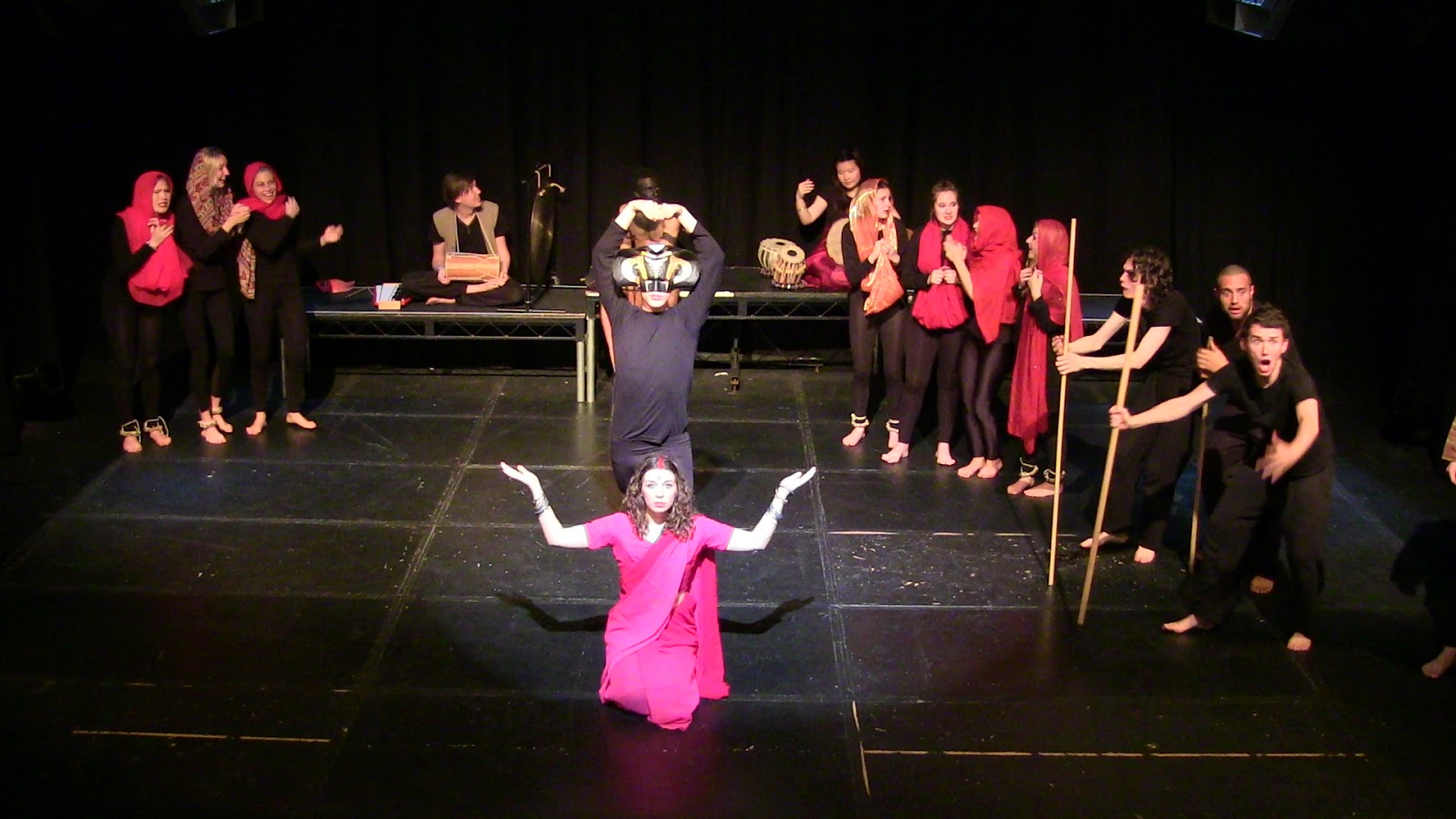
Performance:
An offering in the Yagna of Ranga-Karma
(Searching for a new vocabulary in the contemporary theatre,
Through
the discipline of Natyashastra and other Indian Traditions)
Dr. Satyabrata Rout
Associate
Professor University of Hyderabad
Visiting
Professor at East 15 Acting School, University of Essex, England
 |
A ritual from the play: Urubhangam, Indian Sanskrit drama, presented by-
East 15 Acting students, University of Essex, UK
|
Idea:
Sometimes I wonder how much Indian I am? How much I know my country;
its custom, tradition, philosophy, culture and literature? And I claim to be an
Indian!!! Here in London while teaching Indian theatre to the European
students, I am searching for my identity, my root. Is it not looking bit funny
that in a western Country I am in quest of Indian culture? I am becoming more
Indian than I was in India!!! Why this thought never comes in our own soil to
most of us and all on a sudden it stands before as a question of survival!!!!
Today is Sunday and here in Europe no one works in
holidays. They enjoy... and wake up late. But as an early riser I got up at
4.30 morning. It was going to be dawn and the south end of the sea in England
where I live was waking up to a clear morning after a nightlong rain and
severing cold. All the houses in the lane were still in dark and sea was calm….
Utter silence engulfed the hamlet. In this calm atmosphere I opened my Bhagwat
Gita (the book I always kept with me while on travel) and started reading some
slokas as a usual practice. At one point in Karma Yoga my reading stopped… It
was at the point when Lord Krishna narrates to the depressed Arjuna about the
Karma; deeds:
“sva-dharme
nidhanam sreyah…
para-dharmo bhayavahah…”
Which means:
It is always better to adopt and stay constant in your self-prescribed
duties (Karma) and die for that rather to adopt others’ deeds; however good and
noble it is!
From the outer surface, it has nothing to do with
theatre but somehow I stopped at this point. I have been never rigid to adopt
any creative ideology and issues…. But not blindly…
This sloka seems
to me has a great link with our contemporary theatre practice. In India we have
almost forgotten the value of our Swadharma;
especially in the field of art, literature and culture. Most of our theatre
practitioners have nothing to do with Indian theatre and its discipline and
what to say about our academicians!!! In every step of action, we the so-called
authority of theatre look at the west, which reflects in every inch of our
gesture. Slowly it became a fashion in the theatre world now. We have nothing
to do with our root and yet we call us Indian!!! We have a great treasure of
theatre discipline; Natyashastra and
we have forgotten it!! Why don’t we create our contemporary theatre based on
the treatise of Natyashastra and other deeply rooted cultural discipline? Why
are we looking every time to west like Paradharma
as narrated by Krishna in Geeta?
 |
| Duryodhan crawls on the ground after his theigh id shattered by Bhima (An episode from Mahabharata |
Concept:
Indian culture and philosophy always attracts the
scholars over the world and history witnesses how people from various walks of
life came to India in different phases of time in the quest of knowledge and wisdom!
I am not going to touch that issue… the area is too big to understand. But I
must say about our Indian theatre. Forget about past, in the recent years, in
20th century, theatre practitioners, scholars, theoreticians and
academicians used to come to India to study our discipline and performance
culture, which yet remain alien to most of us! Brecht, Perter Brook, Barba,
Schechner, Tadashi Suzuki, Grotowski and many scholars over the world have
adopted Oriental training system and most of them have travelled a long way to
come here and learn Indian theatre and adopted the techniques for their methods
based on Bharata’s Natyashastra and Ziami’s aesthetic principles.
What is there in Natyashastra that attracts the
scholars over the world to reinterpret, redefine and exploring in many ways? While
experimenting on a kind of training system from this Indian treatise with a
group of western actors, I found the necessity of sharing some of my
experiences and techniques we are adopting from Indian theatre discipline. I
want to put forth the basic fundamental issues that made our Indian training
system more viable among all the disciplines over the world.
Contemporary theatre over the world is undergoing an
identity crisis after globalization. Be it western or Indian the problem
remains the same everywhere. World theatre has already reached its maturity in
the context of technology. But is the application of technology in various ways
and means, called theatre? Is it ever remained as a major demand of
presentation? Off course, it has helped to project us better, to communicate
more meaningfully. But this is not the final goal of theatre. The final goal
lies somewhere else. From the beginning of humanity, man tries to search his
self-identity through the medium of theatre. The communion and human bond is not
other than the theatre activity. Theatre taught us sharing… emotion, feeling,
and knowledge. In this way it contributes to the age-old wisdom of mankind. But
somehow our contemporary practice lacks all these essential elements that
theatre offers. Either we have been trapped into the dark chamber of the
showcase world or we have fallen into the dangerous pit of consumerism. The
spirituality of theatre art; Satwika,
has been faded away from our mind, which was once the driving force of Indian
theatre
 |
| A scene from Nagamandala by East 15 students.... written by Girish Karnad |
Nowhere in the world performance culture, priority
has been given to the spiritual performance apart from Asian theatre, whose
main stream of knowledge is based on Natyashastra. This priceless creation of
Bharata never talks of acting; that
we know in a general sense. It speaks of the Natyam; The performance. Here we perform the characters but not
portray it in a representational manner, as is a common practice in the western
theatre. We portray the characters; not as an incarnation, not as a representation
of life… rather in a presentational style as an offering of the self to the karma, which is abstract, symbolic,
metaphorical and poetic. Natyashastra levelled theatre as Drishya-Kavyam, which means a visual-poetry; a verse, which can be visible and
audible in a given space and time. This discipline of knowledge can never be
achieved through compartmental education system derived by western method, for
which a tree is a tree, a bird is a bird and a house is a house. The system in
west has been developed within their framework and it has its own aesthetics
and presentation style. But for Indian theatre where is the tree and where is
the house? And how we portray it? In an empty space, we perform. We never carry
with us any external elements; set…props…mask… etc. Even no real character! We
even can’t think of any additional elements except our physical presence in the
form of a human body, which is to be offered in the yagyanan of rang-karma as a ritualistic practice. We are necked
actors in an empty space. So metaphorically we create the whole world with the
help of our physical and vocal expressions. And the irony of Indian Theatre is;
it is formed in front of the spectators and dissolved in to emptiness according
to the need and demand of the poetry. We create the drishya and wipe it out the and there in an empty space. But it has
a great philosophical value, which can only be realised through an Indian
sensibility. As Indian philosophy visualises everything as Maya; illusion, performance itself is a great illusion. Sometimes
it becomes visible and in a fraction of second it vanishes and in the next moment
it is realised in the imagination… in thoughts and becomes a concept. This
concept of performance travels in many layers and in any many planes within a
single moment of time and space. It can’t follow a linear journey; it is bound
to be non-linear and is destined to cross all the barriers of logical human
experiences. Finally it elevates the performers and the spectators in to the
state of bliss where the spectator able to test of the rasa of the performance
and enjoy. Then the Yagyan is fulfilled for the wellbeing of the society. It
becomes a celebration of life.
To offer our-self into the holy fire of Yagynan to
achieve spirituality, the performer is bound to go through a strenuous training
process. Natyashastra prescribes four different disciplinary training system
for the performance practice; Angika:
performance through physical behaviour, Vachika:
performance of voice, Aharya:
performance through external elements such as costume, makeup etc. satwika: the spiritual performance.
As a contemporary theatre trainer my aim is not to
pull once again to the convention of classical theatre but to develop a modern
theatre training system which passes through the strong discipline of
Natyashastra tradition and brings the flavours and fragrance of Indian theatre,
which can connect the fragmented performances of actor’s body, voice, and other
visual elements to the soul of the performers and views. Then only it would
become a happening and celebrate life in its full content; as much modern and
contemporary we may be.
To enter into this discipline of theatre one has to
completely surrender him to the training process. In Sanskrit language it is
called Samarpana; an offering of our
body, mind and soul to the karma; our deed. Once a student enters into this
activity, he has to obey and follow all the rituals without any kind of
resistance from his side. In the extreme condition, he even is not allowed to
question to the master, his guru, until the teacher asks him to say. All the
activities are the rituals, which has to be performed by the disciple without
hesitation and the student has to experience this rigorous process through his
body, voice, mind and soul. Theatre, art is a practice of physical expressions
over the world. The tactile experience is termed as Shariranubhuti; experience of the physical being. In this art form
everything is indicated through the physical being of the actor. Until and
unless he passes through the bodily experience, how can he be able to express
the truth of life? That is the reason why in India a Gurukul training system
was developed. The disciple has to spend the entire time with the teacher not
only to be educated but to learn life as well.
As modern theatre trainer it becomes our responsibility
to motivate the students and guide them to pass through this training process. But
it should start from the fundamental level. We have to orient our global
students to understand the essence of the culture, tradition, discipline and
life of an Indian (Indian in true sense). It may be difficult in the beginning
but once they understand, they will love to do it with respect. While working
with a bunch of European students I have also gone through a different
experiences, which I never faced in India. But here in another part of the
world, the culture is different. One can’t change the culture and that should
not the purpose of the training. Here the responsibility of a teacher is more
than the duty of a student; How to orient them towards the discipline of Indian
theatre!
The western compartmental education system stands as a
strong wall in front of us, which has to be cracked to understand the wholistic
approach of Indian theatre. This makes a big difference between these two
cultures;
European training
system is based on specialized pedagogy. For each discipline there are
specializations, which focus to definite subjects. For a student of west, his
whole world encircles around his specialized area and finally he becomes expert
in that. This leads to the concept of division of labour. Theatre pedagogy has
also designed accordingly. The theatre of west has been segmented in many branches
such as; Community theatre, Theatre for higher education, Management and technical
theatre, Acting and stage combat, Physical theatre, World performance, Acting
in Films, Acting for stage, Realistic Theatre, etc… This compartmental
education system creates professionalism. But at the same time it develops one-dimensional
approach. While in Indian system, one has to go through a wholistic training
process. The process is like a ritual, where one activity follows the other in
a systematic order. We don’t have the concept of physical actor, vocal actor,
stylized actor or realistic actor. Our training system in Natyashastra starts
with various foot movements, hand gestures, and exercises of neck, face, eyes
and other smaller units of the body. There are many ways of voice exercises,
which vibrates through different resonators in different emotions. The actor
has to understand the performance techniques of costumes, ornaments, makeup,
etc. And finally in the performance the performer connects all these fragmentation
with soul. Indian performers always practice their own makeup, know the style
of wearing costumes and learn to handle them in the performance. The audience
as an integral part of the rituals, also able to understand the gestures and
movements, though abstract they are. The audience also connects these abstract
hasta mudras (Gestures) and chari (movements) with his constant association of
life and visualizes an imaginary world. The process of performance becomes participation
where both the group (audiences and actors) performs the rituals of
performance. And the play continues in between them. This wholistic approach is
the lifeline of Indian theatre upon which the entire world of performance
pedagogy stands.
Satvikabhinaya:
 |
| The spiritual journey of Duryodhana to Heaven |
The Union of physical being with the soul of the performer:
For the union of body,
mind and soul, and to achieve appropriate expressions, the actor has to pass
through a spiritual journey; a path that leads him to channelize everything to
a single focus. His complete being has to be an offering for the great yagnyan
of performance. In this state of mind; at the union of the soul with the
physical expression, the performer is lifted to the level of blissful ambiance.
The union between the soul and the physical being of the actor, transforms the
performer into a big performance; a great yagnyan. The wall of resistance
dissolves at this moment of time and the performance happens without any
tension, anxiety, pain, hesitation, and resistance. The subconscious of the
performer leads him to behave while his conscious watches him performing. Natyashastra
defines it as Satwika-abhinaya or the
spiritual performance. This is not a performance, rather a state of being; the
absolute truth of the performance. By attaining this state, a performer keeps
him in a level, where all components of his physical and mental being becomes
relaxed so as his performance. The discipline of Indian theatre always
indicates for this spiritual performance that makes Indian training system as
one of the unique method in the pedagogy of world theatre.
While in the beginning
stage a performer may not achieve this state but with concentration and regular
practice he would be able to realize this state of performance. For an urban
actor the training seems difficult but worthy enough to build discipline in him.
Some of the photographs of the plays on Indian theatre
Continued……..